



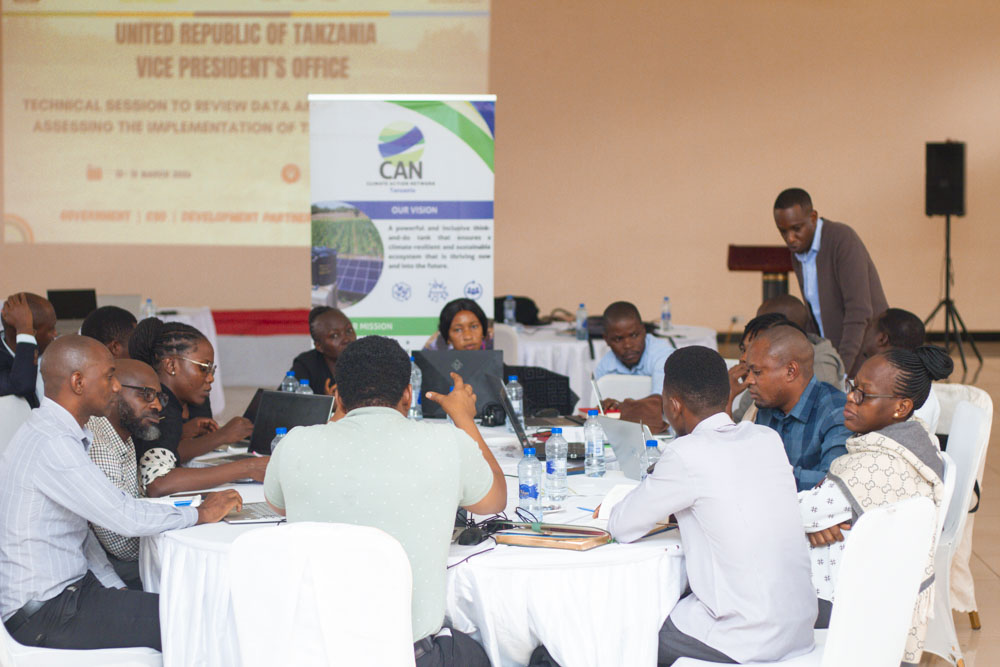
The Vice President’s Office (Tanzania), in collaboration with Climate Action Network (CAN) Tanzania, has convened a two-day national technical session (12–13 March 2026) to review data and sectoral information assessing the implementation status of the National Climate Change Response Strategy (2021–2026), as the strategy approaches its final year.
Held at Nashera Hotel, this technical session brought together representatives from government Ministries, Departments, and Agencies (MDAs), civil society, and climate experts to evaluate progress made under the current strategy, gaps, and identify priorities for the next national climate change response strategy.
The NCCRS (2021–2026) was developed by the Vice President’s Office to guide Tanzania’s response to climate change across critical climate-sensitive sectors, including agriculture, health, fisheries, energy, water resources, forest, transport, to mention a few. As climate change impacts increasingly affect rainfall patterns, food production, and coastal livelihoods, the ongoing review process will help ensure that the next strategy responds to the scale of emerging national and global climate challenges.
Opening the session, Ms. Hadija Kayera, the coordinator for the NCCRS Review process from the Vice President’s Office, emphasized the importance of grounding climate policy in reliable evidence and sectoral experience. She emphasized that the technical session, which focused on reviewing data collected by different sectors on adaptation, mitigation, and cross-cutting issues will later on identify successes and challenges in implementing the current strategy and propose recommendations for the next phase of Tanzania’s climate change response strategy.
During the opening remarks, Dr. Sixbert Mwanga, Executive Director of Climate Action Network Tanzania, highlighted the critical role of partnerships between government and civil society in ensuring climate strategies translate into real benefits for Tanzanian communities. Dr. Sixbert emphasized that stocktaking is essential to ensure the next strategy addresses issues such as Article 6, ongoing NDC 3.0, and alignment with the National Vision 2050.He further emphasized that Climate Change Response strategies must ultimately benefit the people most affected by climate change, including farmers, fishers, and pastoralists across the country. Reviewing the NCCRS helps ensure that the next strategy responds to real experiences from communities and sectors implementing climate action on the ground.
The technical session included sectoral presentations on adaptation and mitigation actions, plenary discussions on implementation challenges, and group work to identify emerging issues and develop recommendations for the next national climate strategy. Experts will also consolidate key findings to inform the NCCRS implementation report and guide the development of the future strategy.
The Vice President’s Office and CAN Tanzania call on stakeholders across sectors to actively contribute evidence and insights to strengthen Tanzania’s climate resilience and ensure that policies effectively support sustainable development.